

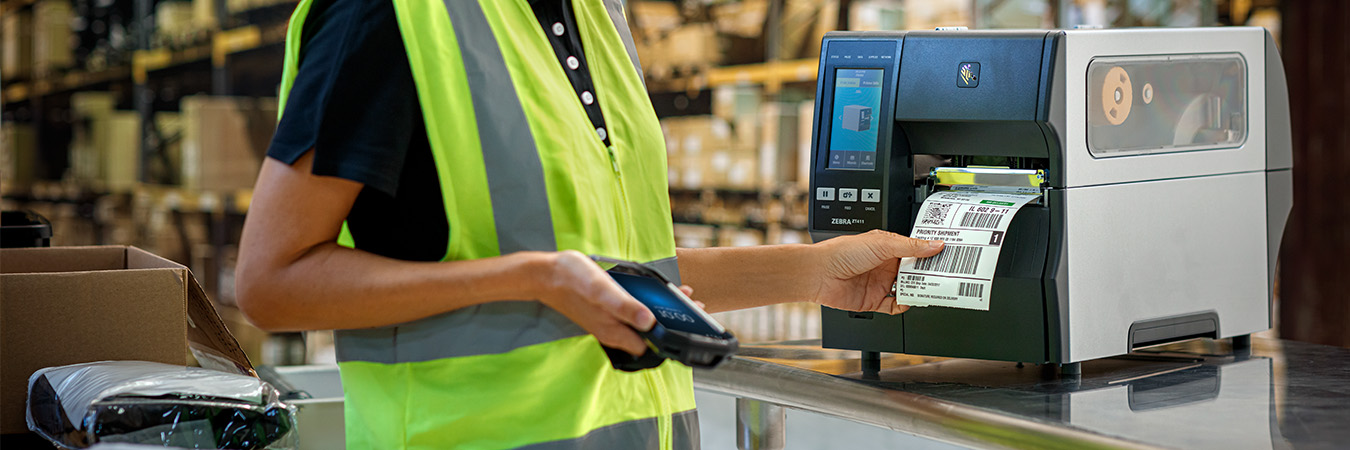
Label printing has seen strong growth in the past decade with the acceleration of e-commerce and the rising use of labels in environments such as healthcare, packaging, product identification, asset tracking, and logistics. IIn our In the Spotlight Episode on the MPS Opportunity for Label Printing, Quocirca talked to Mark Kouwenberg of MPS Monitor and Rich Barfield of Zebra Technologies to find out how a meeting in Amsterdam five years ago has grown into a significant ‘close to home’ opportunity for MPS providers.
Zebra Technologies is best known for its barcode printing and scanning hardware, which it has developed and evolved over 55 years into today’s diverse portfolio, which now includes predictive analytics, machine vision, and autonomous mobile robotics. Zebra has worked with MPS Monitor to add solutions expertise to its label printing proposition.
MPS Monitor supplies office equipment dealers and IT service providers with a secure, cloud-based platform to manage and monitor customer print fleets. The vendor-agnostic platform provides reliable data collection, predictive consumables analytics, and remote support features, all backed by professional support to help partners maximise the platform’s benefits. MPS Monitor’s APIs allow it to integrate easily with ERP systems and CRM platforms, and its embedded MS Power BI provides strong analytic capabilities.
Declining office print volumes drive innovation
Office print volumes have recovered since the pandemic but never reached former levels, and they continue on a downward trajectory as workflow digitisation continues. MPS providers need to diversify to ensure future revenues and customer relevance. Mark and Rich met to discuss this challenge in Amsterdam five years ago, and the result is the companies’ joint proposition for label printing in MPS.
Label printers differ from laser or inkjet printers because they don’t require ink or toner. Heat is applied to the printhead, creating an image of the information to be printed onto the required medium – such as a tag or hospital wristband. This image is created directly by heating thermally responsive media or via thermal transfer through a ribbon made from wax, resin, or a hybrid wax/resin combination, depending on the required performance. This type of thermal print technology is a far more cost-effective way to produce high volumes in retail, manufacturing, healthcare, and logistics industries.
Mark and Rich believe label printing is a more effortless pivot for MPS providers to make than broader moves into IT services, for example. They see it as a potential quick win in a market ripe for a refresh.
Customer pain points in label printing
The label printing landscape is mixed, with what Mark describes as several contradictions.
- An ageing but mission-critical fleet. Label printers are central to core processes, whether preparing products for shipping, printing wristbands in hospitals, or facilitating logistics. If the printer breaks down, there are few alternatives, so there is high dependency on device uptime. However, around 20% of label printers are well beyond the end of their support life – which can be up to 15 years. These devices cannot be managed remotely. They use old firmware and can’t provide proper data. MPS Monitor has developed a data collector so it can discover these Zebra devices, which opens the possibility of firmware refreshes, but ultimately, there is a big opportunity to replace ageing fleets.
- Lack of fleet visibility. Related to the above, very few customers know the size and status of their label printer installed base. Devices are out of sight physically on shop floors and digitally because they have low network presence. Larger customers may have thousands of devices they are not monitoring. Many Zebra devices are also USB-connected, which adds further difficulty to fleet management. To solve this, MPS Monitor has developed an agent that can manage Zebra USB-connected devices.
- Poor security. Mark and Rich quote the companies’ own analysis that shows more than 62% of all label printers are not using the latest firmware or security patches, and many are still at factory settings. This is a significant threat to IT infrastructure and an opportunity for MPS providers to offer consultancy to help businesses address the security gap.
- Challenging consumables management. Label printers don’t have the onboard intelligence of modern multi-function printers and can’t signal that they are out of labels or ribbons – which are the only consumables as there is no ink or toner. To solve this challenge. MPS Monitor has developed solutions for measuring label consumption, enabling proactive restocking.
These challenges represent a key opportunity for MPS providers, which already have relevant in-depth knowledge of the print industry. It simply requires them to ‘walk through a different door’ with buyers, exploring environments such as factory floors, warehouses, shop floors, and places where high-value assets are tracked.
The market for label printing is growing. Accelerating e-commerce and increasing sophistication in supply chain and logistics management are all driven through intelligent labels that act as digital triggers, integrating with management and tracking systems. New regulations, such as the EU Green Deal’s digital product passport requirement, will also impact the market, requiring products to carry labels containing much more detailed information.
MPS Monitor’s solutions for data collection, firmware analysis, remote management, and consumables monitoring enable MPS providers to add an another strand to their offering, giving customers greater control over this aspect of their print environment. The solution integrates with MPS Monitor’s conventional print management solution, allowing providers to simply extend device oversight to the Zebra label printer estate.
Quocirca opinion
MPS Monitor and Zebra Technologies have built a compelling proposition for this ‘close to home’ opportunity by solving many existing challenges associated with label printing, such as fleet visibility and consumables management. The growing market means this should be an area of consideration for providers seeking to diversify from conventional office MPS. By opening doors to other departments, there may also be opportunities to increase the penetration of traditional print fleet engagements.
Watch the full In the Spotlight Episode with Quocirca, Zebra and MPS Monitor